
A3 Problem-Solving Method
What is A3?
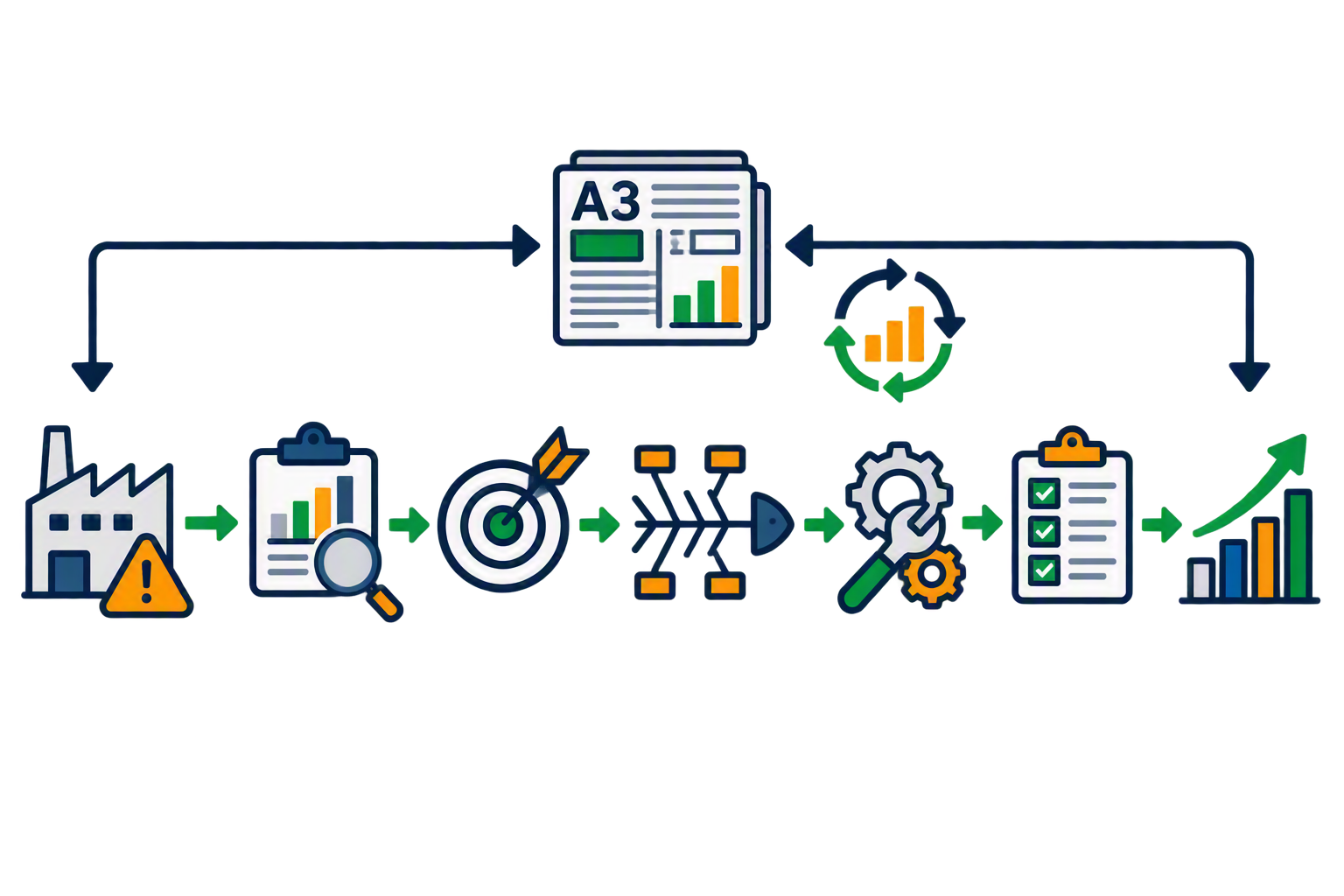
A3 is a way to conduct and present a problem analysis: from the current state and target, through causes and actions, to verification of the result. In the classic version, the key findings fit on an A3 sheet. The sheet itself does not solve the problem; it helps the team follow a logical process.
Training objective
I teach how to address simple, clearly bounded production problems without jumping from a symptom to an unverified solution. Participants practise defining the problem, gathering data, analysing potential root causes and planning how to check whether the actions worked.
A3 variants and the link to 8D
Companies use different names, including A3 Problem Solving, Problem Solving and Simple Problem Solving. Sometimes the whole analysis fits on one A3 sheet; elsewhere each stage has a separate sheet and the A3 is a summary. I can use the client's format if it preserves the method's basic principles.
Some organisations combine A3 with elements of 8D, especially when the customer needs protection. They are not the same method: 8D explicitly separates temporary containment actions.
Examples of suitable problems
Exercises can address observable, measurable issues in a defined part of the process, such as:
- defects appearing during transport between operations;
- repeated incorrect clamping of one component during assembly;
- an incorrect label applied at one packaging operation.
Each example concerns a specific nonconformity, not a broad goal such as “improve quality”. More complex problems requiring extensive analysis are covered in my other courses.
Teamwork and problem-solving stages
I show the team how to define the gap between the expected and actual state, collect data, find and verify the root cause, select actions, assign responsibility and assess the outcome. Observing the process and talking to the people doing the work are essential.
Problem-analysis tools
Tool selection depends on the problem. 5W2H helps describe the event and its circumstances; “5 whys” helps examine a selected cause more deeply. Exercises may also use brainstorming, an Ishikawa diagram or a Pareto chart. Elements of SPC and process capability analysis are possible.
Participants learn to choose the information and methods needed to identify the root cause, measure and improve the process, and verify the effectiveness of the actions.
Training and workshop
I teach using a prepared production example. The workshop may use a simple problem from the client's plant if a specific process and basic current-state data are selected beforehand. Together we prepare the analysis and a plan for action and verification. If later trials or observations are needed, I do not promise to solve the problem during the workshop itself.
The training and workshop plan depends on the selected problem and available data. Ask for a detailed training programme.
Training outcomes
Participants can prepare a clear A3, justify their choice of actions and define how to recognise an improvement. They gain a starting point for conducting similar analyses in their daily work.
Who is it for?
- operators;
- team leaders;
- quality and maintenance staff;
- process engineers;
- people beginning to work with Lean.
Organisation
- Duration: one training day, or one to two days with a workshop.
- Recommended group size: 5–10 participants.
- Location: the client's plant.
- Format: a prepared production example or a workshop on a real process.
- The workshop requires access to the process and the opportunity to observe it and collect data.
- Price: agreed individually.
Training cost
The price of dedicated training is agreed individually.